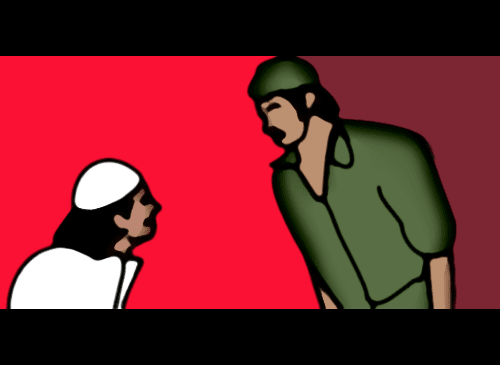
Anwar (2007) provides beautiful commentary on multiple characters and their complex relationships with one-another.
Anwar (Siddharth Koirala) is a young Indian Muslim, who lives in a humble middle-class part of town. The middle-class in India is relative to the working-class in Britain.
Anwar’s an art student and his current university project requires the research of historic Hindu temples.
Meanwhile Anwar’s mother, who lives with Anwar and his sister, decides to rent out one of her free rooms to a single parent and her daughter – an attractive young woman by the name of Mehru (Nauheed Cyrusi).
Anwar (2007) is a well-executed film. But vaguely reading through other reviews I doubt it is as popular or renowned as it should be. After all, it did tank at the box office.
The general criticism I came across for the film was the slow pace of the screenplay. There’s no overt flashiness to seduce you. Also it can come across as a controversial script because of the community rifts it exposes.
But I appreciate the film’s pace.
Its cinematography is quietly beautiful. I enjoyed the calming hills and cliff sides on the outskirts of the city, the charming Indian neighbourhoods and temples, plus in noted scenes: the vivid blue of Krishna’s skin with the redness of his turban.

For a film which is a long theatrical study into bonding and conflict, the script plays out as it should.
It’s a film for thinkers, wanderers, and lovers. As you invite the sweet melodies of Krishna’s flute playing in your ear, you more importantly achieve a better understanding of the discrete multicultural, political, and personal afflictions which inherently affect most people unknowingly on a daily basis as they go on with their regular lives.
Manish Jha is the writer and director of Anwar (2007). He has directed four films collectively, Anwar being his second¹.
On his research journey, Anwar comes across temple aficionado Master Pasha (Vijay Raaz).
Alongside knowledge of temples, Master Pasha is a wizard in the subjects of love, storytelling, acting, music, Indian history, and friendship. He’s not a successful man by society’s common yardstick. Scenes expose him as a beggar who pretends he’s suffering from ailments so he can earn to eat. However to Master Pasha this is a Shakespearean art form of the highest order. He sees himself as a true actor who is sharpening his craft.
Vijay Raaz excels as Master Pasha. His performance is incredible. I’d be right in saying his dynamic role is probably worth watching the whole film for.
Anwar falls in love with his lodger Mehru and is under the impression she likes him the same. However, Mehru is interested in Anwar’s good friend Udit (Hiten Tejwani).
Udit is a more realistic proposition to Mehru. He’s studied a good university course, he’s going to land a good job in the States, and he’s not as naïve as Anwar.
I describe this as the Wolverine vs Cyclops phenomenon.

I feel women will fool around with the raw and dynamic Wolverine, like Jean did, but always settle with the safer option of Cyclops. I’ve seen this time and time again and unfortunately experienced this on both sides of the mutant playing field! Although, I might just be blaming my shortcomings on a nil-portfolio of assets…
When Anwar learns of his unrequited love, his feelings fizzle into heartbreak and envy. His first advice for the couple is that they’ll never be able to have a long-term relationship anyway because Mehru is Muslim and Udit is Hindu. Udit is adamant that these boundaries don’t matter anymore.
Parindho main kabhi firqa’parasthi takh nahi hothi— Kabhi mandhar pe jah bethe, kabhi masjid pe ja bethe.²
The leaves never have sectarian anomosity— Sometimes they rest at the temple, sometimes they sit at the mosque.
– Man Qunto Maula, Sufis of Nizamuddin
A point to be noted is just how embedded the Muslim-Hindu split is in the subcontinent. The two sides have been clashing heads through centuries of conflict, sometimes brewed by one or the other, and at times this rift has been manipulated by others – like the British Raj³. The cycles of power have had their spikes and dips and both factions have had their seat on the throne.
Currently, BJP hold power in India. An ultranationalist, pro-Hindu political party with their leader supposedly having links to the Gujarat massacre of Muslims circa 2002⁴.
Also, I think we all do crazy things when it comes to heartbreak sometimes. Especially if it’s a heartbreak earlier on in life. For men too, I think we hurt more in break ups anyway when we’ve invested time and love into a woman.

Anwar’s reaction to Mehru’s preference of another partner breaks him, and he lets his emotions get the best of him.
Sab’ki Sakhi pe nazar ho… ye zaruri hai magar… Sab pe Sakhi ki Nazar ho… yeh zaruri toh nahi⁵
Our eyes being on the Bartender are a must, but the Bartender’s Eyes don’t have to be on us…
– Boohey Barian, Hadiqa Kiani
In classic Sufi poetry, unrequited love has its own standing and importance. Obviously, these poems are dedicated to a Guide or Higher Power like God, but interpretation is on the reader. Some of these poems are open-ended and are referred to as Ishqiya-Shayri⁶’⁷(passionate-love-poetry). These can be devoted to anyone from God to a Lover depending on your own interpretation of the words.
It’s why in old Ghazals⁸ (genre of poetry dealing with worldy and spiritual love) there is such an emphasis on pursuing unrequited love even if it’s unsuccessful. It is a chapter men strive for. Master Pasha’s intense devotion to an unfair love could be homage to this cultural phenomenon.
In the end, Anwar makes terrible decisions and loses the people closest to him. I found his behaviour childish and unnecessary. Unfortunately he reaps what he sows.
He soon finds himself alone with his temple sketches and notes, inside a small temple, sitting in a majority Hindu populated area. Anwar’s abrupt appearance alerts locals that a possible terrorist looking to damage Hindu places of worship, rests inside one.
The director explores discrimination against Muslims and conflict with a wide lens. There are scenes which confirm a lot of Hindu-Muslim conflict as being brewed by the media and politicians, which then seeps through and infects everyday people.
For example, Anita (Manisha Koirala), a TV journalist, looks to make her news story more sensational if Anwar is labelled a definite terrorist.
Or the slightly mad and overly paranoid Gopinath (Rajpal Yadav) who thinks he is aware of Osama Bin Laden’s presence in Lucknow and actually tries alerting George Bush about this… by email…!!!
I’m serious!
The film’s narrative is subjective and provoking.
Nothing is one dimensional. Anwar’s Muslim identity is just one part of the storyline in a long and overlapping sequence of events.
There are many scenes where Anwar, a Muslim man, imagines himself and Mehru as metaphors of the Hindu God Krishna and his lover Meera. I think that wonderful contrast is intentionally interesting and adds an important dimension to the screenplay.
The final scene left me in goosebumps. The boy draped in India’s tricolours, lost for the majority of the film, makes an appearance again during the last scene. The story leaves you with so many questions about how that young man is going to grow up. After all, he’s witnessed the death of an enemy. He’s already initiated into the midst of a mob; cheers echoing around him, unaware they’ve perhaps started another cycle of hate.

I wonder how this film would play out in today’s political landscape. Pakistan, India, and Bangladesh seem to be cooking in the fire of caste and religious disputes now more than they ever have.
I know some of songs from the film are treasured and respected, and rightfully so because they’re brilliant, but I’m still unsure where Anwar (2007) sits in the library of Hindi films released in the 2000s.
Any film which challenges the human condition is one worth watching. Lots of the film is about love and conflict, but beyond that, the film is about people and how the bitesized decisions they make, knowingly or unknowingly, recklessly shatter hundreds of other lives.
References:
[1] IMDb. “Manish Jha | Director, Writer, Actor.” IMDb, IMDb.com, http://www.imdb.com/name/nm1162002/.
[2] Mathur, Rathin. Man Qunto Maula- Sufis of Nizamuddin, YouTube, 23 Mar. 2016, http://www.youtube.com/watch?v=qHTEwxOvsYI.
[3] Knowledgia. THE HISTORY OF INDIA in 12 Minutes – Part 1, YouTube, 21 Nov. 2020, http://www.youtube.com/watch?v=ofgIDZHTjTQ.
[4] Sharma, Rakesh. “Final Solution (2004).” Independent Documentary, MUBI, mubi.com/en/gb/films/final-solution-2004.
[5] Salli, Yousaf. Boohey Barian | Hadiqa Kiani | Live in Concert | Virsa Heritage Revived | Official Video, YouTube, 17 June 2018, http://www.youtube.com/watch?v=_yiSVpTihb8.
[6] Rekhta Dictionary. “Meaning of Ishqiya-Shairi in English.” Rekhta Dictionary, http://www.rekhtadictionary.com/meaning-of-ishqiya-shaairii.
[7] Justice Markandey Katju. “The Concept Of ‘Ishq’ In Urdu Poetry.” NayaDaur.TV, 21 Nov. 2020, https://nayadaur.tv/21-Nov-2020/the-concept-of-ishq-in-urdu-poetry.
[8] Rekhta Dictionary. “Meaning of Ghazal in English.” Rekhta Dictionary, http://www.rekhtadictionary.com/meaning-of-gazal.
[9] Oriental Star Agencies Ltd. Tum Ek Goorakh Dhanda Ho, YouTube, 23 Apr. 2016, http://www.youtube.com/watch?v=mXY5-TK2sJ0.
Leave a Reply